 USA
USA UK
UK Australia
 UAE
UAE Canada
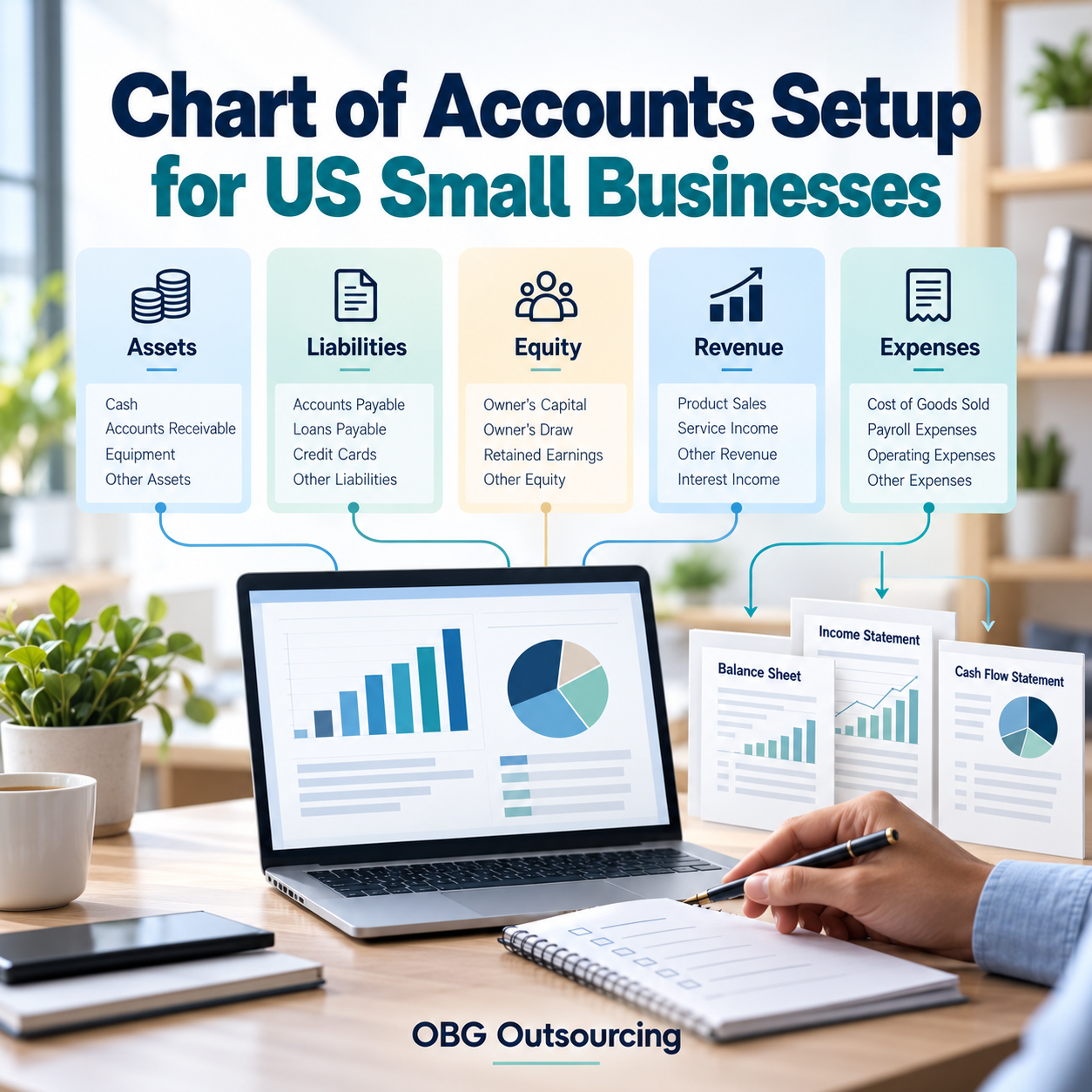
Your financial reports are only as useful as the records behind them. If the same expense appears under different categories each month, or all revenue goes into one account, it becomes harder to understand how your business is performing.
A thoughtful chart of accounts setup gives every transaction a consistent place in your books. For owners and finance managers balancing accounting with daily operations, outsourced accounting services can help establish that structure and maintain it as the business grows.
At OBG Outsourcing, we help small businesses connect their accounting setup with ongoing bookkeeping support, so an organized account list becomes part of a reliable financial routine.
What Is a Chart of Accounts?
A chart of accounts is the organized list of accounts used to classify transactions in your general ledger. It includes categories for what your business owns, what it owes, owners’ equity, revenue, and expenses.
Think of it as the filing system for your financial activity. Clear account names and consistent classifications make transactions easier to record, review, and report.
For small business accounting, the goal is a structure that provides useful detail without making everyday bookkeeping unnecessarily complicated.
The Main Categories in a Small Business Chart of Accounts
Most businesses organize their accounts around five basic types. The examples below are a starting point; the accounts you need depend on your operations and business structure.
| Account type | What it tracks | Common examples |
|---|---|---|
| Assets | Resources the business owns or controls | Checking accounts, accounts receivable, inventory, equipment |
| Liabilities | Amounts the business owes | Accounts payable, credit cards, business loans |
| Equity | Owners’ interest in the business | Owner contributions, retained earnings, distributions where applicable |
| Revenue | Income earned from business activities | Product sales, service revenue |
| Expenses | Costs incurred to operate the business | Rent, insurance, software subscriptions, advertising |
Assets, liabilities, and equity appear on the balance sheet. Revenue and expenses appear on the profit and loss statement. Cost of goods sold is commonly presented separately from operating expenses to help show gross profit.
The account type selected in your accounting software determines where information appears in these reports.
How to Set Up a Chart of Accounts That Fits Your Business
1. Start With the Questions Your Reports Need to Answer
Before adding accounts, identify what you want to learn from your financial statements.
Consider questions such as:
How much revenue comes from product sales versus services?
How much are you spending on advertising?
What does it cost to deliver a particular service?
For example, a consulting firm offering one-time projects and ongoing retainers may want separate revenue accounts for each. A retailer may need inventory and cost of goods sold accounts.
Use these reporting needs to guide the setup. A template can provide a starting point, but review each account before adopting it.
2. Confirm Your Accounting Method and Business Structure
Your setup should support the accounting method your business uses and the reporting requirements your accountant identifies. Discuss cash versus accrual accounting, inventory, payroll, and owner transactions before finalizing the chart.
Equity accounts also need to reflect your entity structure. An account list designed for a sole proprietor may require changes before it is appropriate for a corporation.
Resolve these decisions early so the person recording transactions has clear instructions. The IRS permits recordkeeping systems suited to the business that clearly show income and expenses, while noting that the business’s activities affect the records needed for federal tax purposes.
3. Use Clear Names and a Consistent Numbering System
Choose account names that your team can understand immediately. “Software Subscriptions” is easier to apply consistently than a vague label such as “Other Business Costs.”
If account numbers are useful, an illustrative structure is:
| Number range | Account group |
|---|---|
| 1000–1999 | Assets |
| 2000–2999 | Liabilities |
| 3000–3999 | Equity |
| 4000–4999 | Revenue |
| 5000–5999 | Cost of goods sold or cost of services |
| 6000–6999 | Operating expenses |
Note: This is an organizational example, not a prescribed US numbering standard. Leave room for additional accounts and keep naming conventions consistent.
4. Add Detail Where It Helps You Make Decisions
Too few accounts can hide useful information. Too many can make categorization inconsistent.
For example, a business that closely monitors marketing spending might use an Advertising parent account with subaccounts for paid search and social media advertising. A business with limited advertising activity may only need one account.
Avoid creating a separate general ledger account for every vendor or customer. Consider the customer, vendor, project, or departmental reporting features available in your software before expanding the chart.
5. Validate Opening Balances and Transaction Mapping
When setting up a new system or reorganizing existing books, establish a clear starting date and verify opening balances against supporting records.
Review how bank transactions, customer invoices, vendor bills, payment processing activity, and payroll entries reach the general ledger. Automated categorization still needs review.
Before making the setup your everyday process, test representative transactions and inspect the resulting reports. Ask whether the reports answer the questions you identified at the start.
6. Document How Accounts Should Be Used
Add short descriptions to accounts that could be confused with one another. Identify who can create new accounts and who reviews unusual transactions.
For existing books, assess the effect on historical reporting before merging, renaming, or making accounts inactive. Keep a record of approved changes so future reviewers can understand them.
Common Chart of Accounts Problems to Address
A useful review should look for:
Duplicate accounts: Similar expenses split across “Office Costs,” “Office Expenses,” and “Office Supplies.”
Overused miscellaneous categories: Transactions grouped together without enough detail to explain them.
Incorrect account types: An account assigned to the wrong financial statement category.
Inconsistent transaction coding: The same type of purchase classified differently from month to month.
Uncontrolled account creation: New accounts added without checking whether an appropriate one already exists.
Fixing the account list is only part of the work. The underlying transactions and the process that caused the problem may also need attention.
Why Ongoing Outsourced Accounting Services Matter
A chart of accounts can become less useful when new revenue streams, expenses, or software connections are added without review.
Ongoing bookkeeping services help put the structure into practice through consistent transaction recording, reconciliations, and regular reporting. A practical monthly review should also identify unclear entries, unexpected balances, and categories that no longer provide useful information.
When comparing US business accountants and accounting outsourcing companies, ask how they handle both initial setup and ongoing maintenance.
Before selecting a provider, clarify:
Who reviews your books?
How are accounting questions resolved?
Which financial reports will you receive?
Who approves changes to your chart of accounts?
How OBG Outsourcing Supports Your Accounting
At OBG Outsourcing, we provide chart of accounts setup alongside bookkeeping and accounting support for businesses that need an organized financial foundation.
Our services include:
Transaction recording to keep day-to-day financial activity organized.
Bank and credit card reconciliations to identify discrepancies.
Financial reporting to support regular reviews of business performance.
For a new business, that support can begin with establishing appropriate account categories. For an existing business, the starting point may be reviewing the current structure and identifying where cleanup is needed.
Our outsourced accounting services connect that initial work with ongoing support. The aim is to give owners and finance managers records they can review consistently, with account categories that remain useful as operations change.
Get Started With OBG Outsourcing
Ready to organize your books? Contact OBG Outsourcing to discuss chart of accounts setup and ongoing bookkeeping services for your US small business.
_(6).jpg)


1.png)
_(5).jpg)
.jpg)
_(4).jpg)
_(1).jpg)
_(2).jpg)
.png)